Extended Dominant Series, Deceptive Resolution of Secondary Dominants, and Voice Leading
Introduction
In lesson 2 we'll learn about a new use of the dominant 7th chord–the extended dominant series. We'll explore some common deceptive resolutions of secondary dominant function chords. We'll also learn to express extended dominant function chords as chord scales and practice voice leading the extended dominant series in three, four, and five voices.
Objectives
By the end of the lesson, you will be able to:
understand the concept of the extended dominant series as distinct from secondary dominants
recognize an extended dominant series in a piece and analyze it correctly
express extended dominants appropriately as chord scales
recognize common deceptive resolution patterns for secondary dominants and analyze them appropriately
realize chord progressions that include both extended dominants and secondary dominants in four and five voices with and without tension substitutions
Sliding Home: Extended Dominants

Imagine that you are in an amusement park at the top of a large water slide. You enter the chute and start your descent. You bank and drop from level to level with increasing momentum excitedly anticipating the moment when the inevitable pull of gravity causes you to arrive in one big final splash! In this topic we will investigate a kind of chord progression that produces a similar musical sensation: the extended dominant series!
Harmonic Rhythm on Secondary Dominant Chords
Let's review some concepts. In level 2 of this course we discussed the effect of harmonic rhythm on secondary dominant chords. In general, a secondary dominant that falls on a weak metrical stress creates an expectation of resolution to its diatonic goal chord on the next strong metrical stress. This creates a sense of forward momentum in the chord progression.
Secondary Dominants in Relation to the Metrical Stress Pattern:
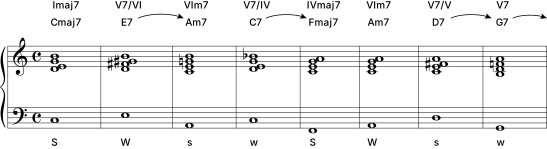
The exception to this is the secondary dominant V7/V. Because the V7/V's diatonic goal is V7 (most often heard on the weak stress preceding tonic), V7/V appears on the strong stress that precedes V7.
The V7/V is in effect substituting for the diatonic II-7 chord. The result is a brighter, more insistent version of II7-V7-I, because tonic is preceded by not one, but two dominant function chords whose roots are a perfect 5th apart. For me, this progression is the musical equivalent of sliding into home plate in a baseball game. At the V7/V the runner starts an explosive charge toward home, when V7 hits the dirt and slides safely into home (I, the tonic) to score a run!

Sliding Home
Extended Dominants
Positioning a dominant chord on the primary metrical stress point in a phrase can set the stage for even longer stretches of dominant resolution. Tunes such as Gershwin's "Nice Work If You Can Get It" and "I Got Rhythm" and Duke Ellington's "Prelude to a Kiss," and the theme song from the cartoon series "The Flintstones" all contain extended dominant series: A string of three or more dominant chords that start on a strong harmonic stress point, and resolve, one to the next, by descending perfect-5th root motion.
In addition to the descending perfect-5th root motion, the parallel chromatic scales in the essential voice leading (guide tones) create a very strong progressive pattern that continually delays resolution and a sense of rest. As each dominant chord has the potential to resolve to its respective key, our sense of normal diatonic function is temporarily suspended while we are carried along by the continuous restless dominant motion.
Extended Dominant Series:
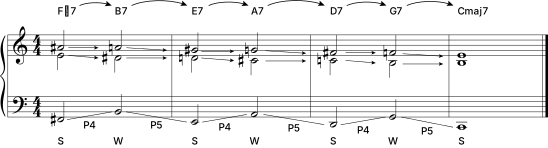
Quite different from secondary dominants, the extended dominant string is, in effect, a backward extension of the sound of V7/V to V7 to I. Each dominant chord that precedes the secondary dominant is another level removed from the final goal chord:
Extended Dominant Series Resolving to I:

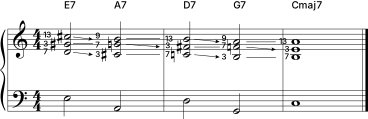
To further imitate the sound of the V7/V, secondary dominants may be voiced with tensions 9 and 13. This will cause the first of a series to sound clearly nondiatonic as many of the critical notes in the voicing will be from outside of the home key.
In the illustration below, the voicing of E7 will disrupt our sense of C major because each of the roots of the primary functions—tonic, subdominant, and dominant have been raised by one half step. As the extended dominant series progresses toward tonic the tensions gradually become diatonic to the home key.
Extended Dominant Voiced with Tensions 9 and 13:
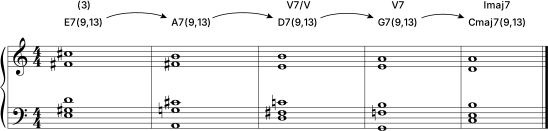
The effect of the extended dominant series is both disruptive to our sense of the tonality as well as being strongly progressive. It's as though we have been lifted out of the key temporarily but can really feel the increasing pull toward resolution with each successive dominant chord.
In George Gershwin's classic song "I Got Rhythm" (AABA form), the key of B
Extended Dominant Series in the Bridge of “I Got Rhythm:"

It's as if we have suddenly found ourselves on an express train to tonic rather than one that stops at each local diatonic station!

Express Train
Analyzing Extended Dominant Series
Extended Dominant Series Analyzed Incorrectly with Roman Numerals:
To reiterate, extended dominants are not secondary dominants but rather a backward extension of the V7/V to V7 progression. The V7 of V preceded by the V7 of the V of V preceded by the V7 of the V of the V of V and so on. Since an ever-increasing stack of Roman numerals quickly reaches the point of absurdity, we use a different more visually economic approach for analysis of extended dominant series:
The arrows show the pattern of dominant progression.
The chord root that starts the series is labeled as a reference to the tonal center.
Extended Dominant Series in “I Got Rhythm:”
Melody and Extended Dominant Progressions
An extended dominant series is essentially a harmonic sequence. Not surprisingly, melodies written over this progression tend to be sequential in nature as well. The following are two very well-known tunes composed over extended dominant series:
Melody of the Bridge of George Gershwin’s "I Got Rhythm:"
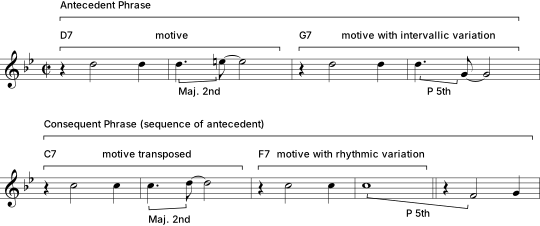
In the melody in the bridge of "I Got Rhythm" the motive in measures 1-2 is repeated three times. The first repetition involves an intervallic variation; instead of ascending a major 2nd, the melody descends a perfect 5th. Mm. 1-4 create an antecedent phrase. In mm. 5-6 the original motive has been transposed down a major second. Mm. 7-8 involve a rhythmic change combining the rhythmic values of the second measure of the motive into a whole note. This delays the descending perfect 5th, which occurs as the first note of the returning A section. Notice how Gershwin cleverly eludes the bridge with the return of A by delaying the resolution of this interval! Mm. 5-8 are the consequent phrase for mm. 1-4. Mm. 5-8 (with the first note of the returning A section) are an exact sequence of the pitches of mm. 1-4.
Melody of the Bridge of “Meet the Flintstones:”
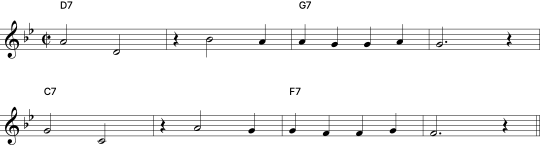
Measures 5-8 of the bridge of "Meet the Flintstones" is a diatonic sequence of mm. 1-4.
Other Uses of the Extended Dominant Series
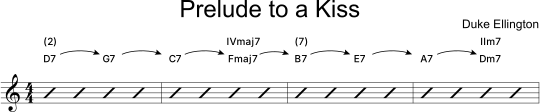
An extended dominant string can also lead to diatonic goal chords other than Imaj, as in measures 2 and 4. Duke Ellington used this technique effectively in "Prelude to a Kiss."
Extended Dominant Strings Resolving to Different Diatonic Chords:
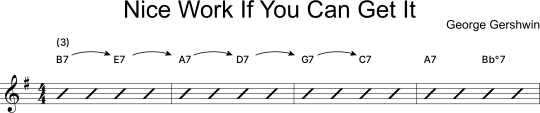
In some cases, they may not resolve at all. This unusual progression in the key of G is from Gershwin's "Nice Work If You Can Get It":
Extended Dominant String, Indefinite Ending:
Workshop: Extended Dominant Series
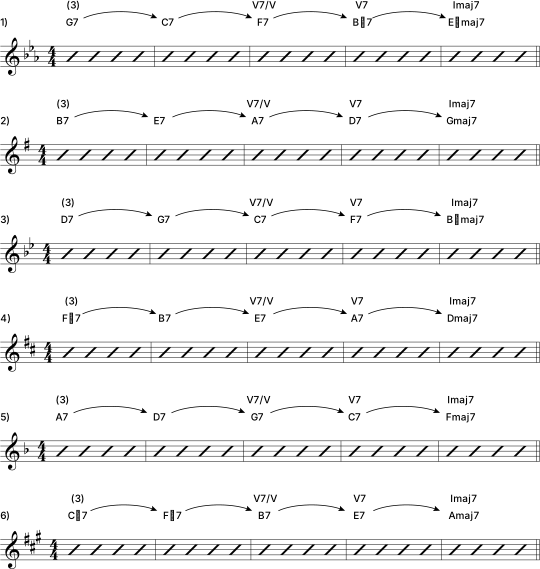
To get familiar with the extended dominant series, download the attached PDF and work out each of the progressions from the given scale degree. Be sure to note the key signature of each exercise. Express the progression with chord symbols and then use arrows and Roman numerals (where appropriate) to analyze each progression. Check and correct your work against the answer key provided.
Download Extended Dominant Series Workshop (PDF)

Laying It Out: Expressing an Extended Dominant as a Chord Scale
As you learned in the last topic, extended dominants are an extension of the sound of the V7/V. As such, they are voiced with tensions 9 and 13.
Extended Dominant Series Voiced with Tensions 9 and 13:
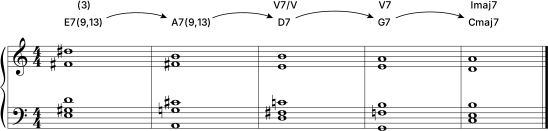
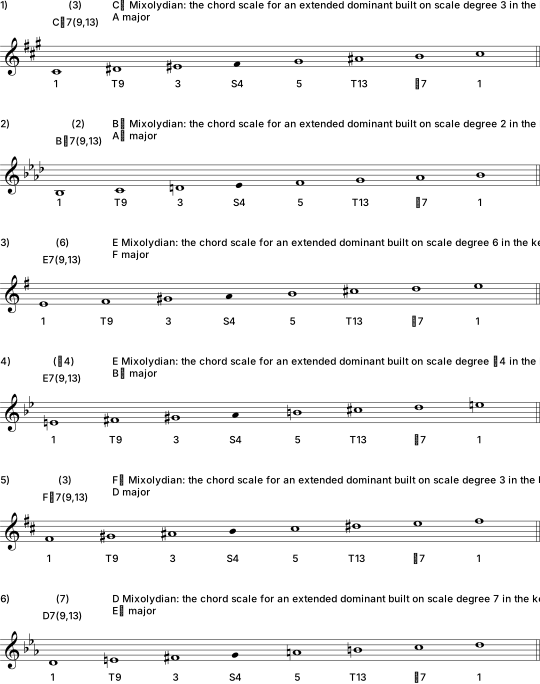
This in effect, places the chord outside of the key, as the tensions in most cases will not be diatonic. To express an extended dominant as a chord scale, simply write the Mixolydian scale from the chord's root.
Chord Scale for an Extended Dominant Chord:

Workshop: Chord Scales for Extended Dominant Chords
Practice writing chord scales for extended dominant chords. This is conceptually a little tricky in that you need to write the correct pitches for a Mixolydian scale while still acknowledging the key signature. Check and correct your answers by using the answer key provided.
Download Chord Scales for Extended Dominant Chords (PDF)
Expect the Unexpected: Deceptive Resolutions of Secondary Dominants
Having our expectation fulfilled or defeated is essential to the narrative power of music. In this topic we will recognize common deceptive resolution patterns for secondary dominants and analyze them appropriately.
Common Patterns of Deceptive Resolution
While in most cases secondary dominant chords energize a chord progression and resolve to the target chords that they project, a number of common patterns of deceptive resolution occur in the repertoire. The following are the most common:
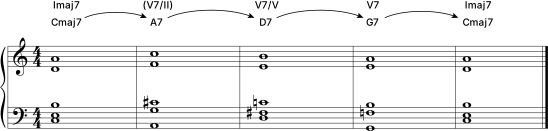
In the first example, the A7 chord with its diatonic tensions 
Please note that while three dominant function chords appear consecutively, this is not an extended dominant series. First of all, the A7 chord occurs on a weak stress in the harmonic rhythm. And secondly, it is voiced with diatonic tensions further increasing the expectation that it will resolve to diatonic D-7.
Deceptive Resolution of V7/II to V7/V:
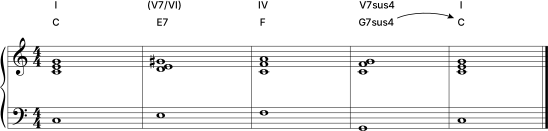
In this next example the E7 chord sets up a very strong expectation of resolution to VI-. While the F chord shares a number of crucial tones in common with the expected A-, its root F defines it as having subdominant function. The net result is deceptive. In a way the move up by step is not unlike the deceptive resolution of V7 moving to VI-. Similarly, (V/IV) II- is a possibility, but it is not a very common pattern.
Deceptive Resolution of V7/VI to IV:
Deceptive Resolution of the V7/VI to II-7:
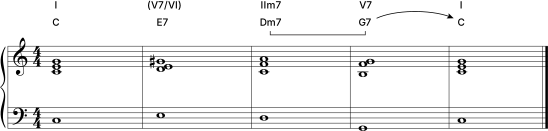
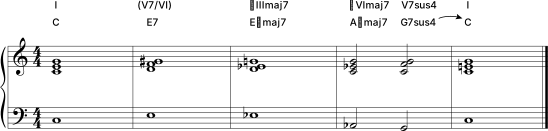
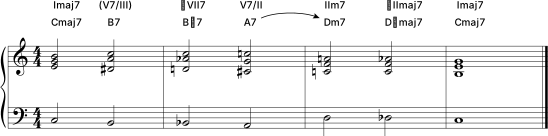
What follows are a few additional possible deceptive resolutions of secondary dominants:
Deceptive Resolution of the V7/VI to
Deceptive Resolution of the V7/III to
Deceptive Resolution of the V7/V to
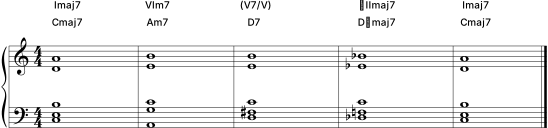
In the examples above, the secondary dominant chord with its diatonic tensions creates an irresistible expectation of resolution to the standard diatonic target chord a perfect 5th below. The move down a half step is logical because of the strength of descending root motion by minor 2nd. The aural result of the move to these modal interchange chords with their non-diatonic roots though is anything but expected!
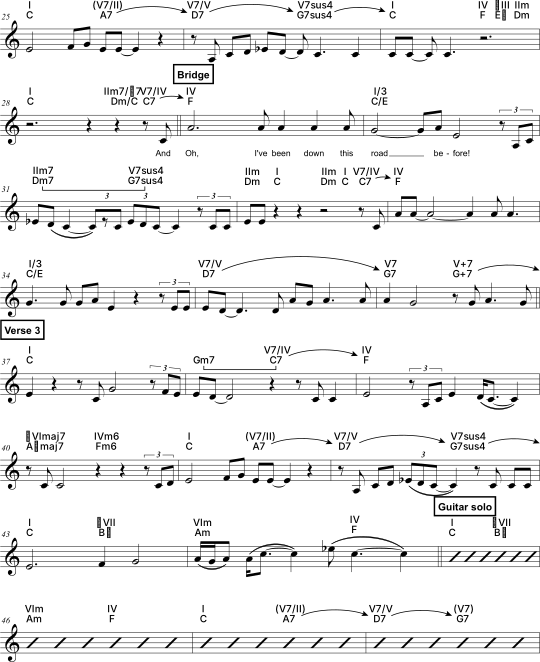
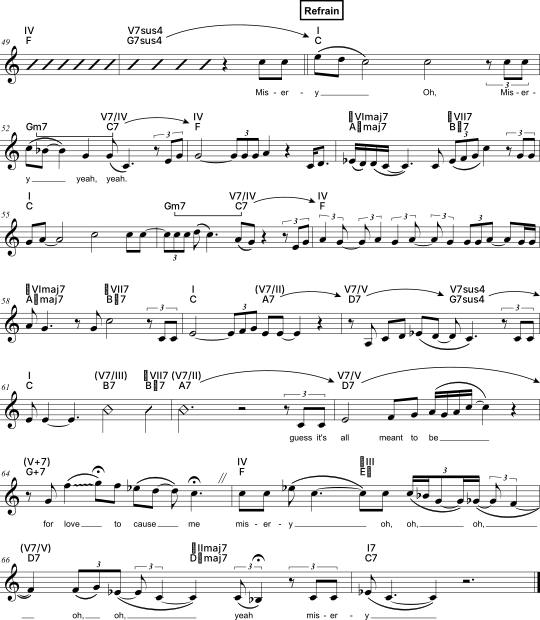
Workshop: "Misery,” Deceptive Resolutions of Secondary Dominants
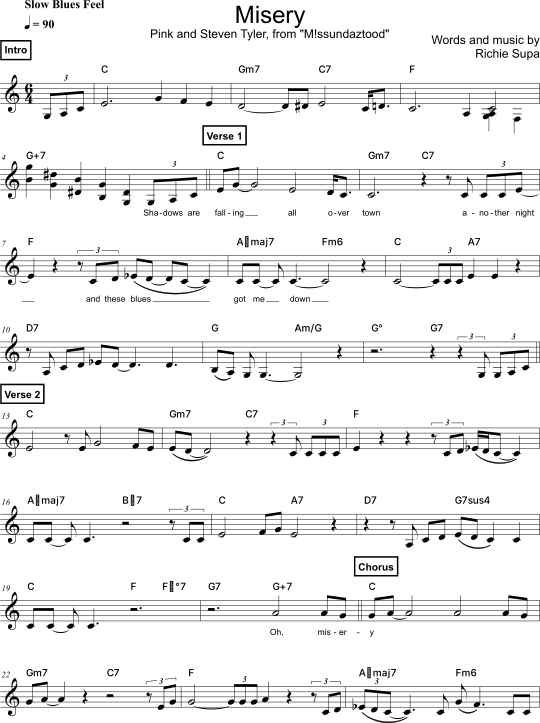
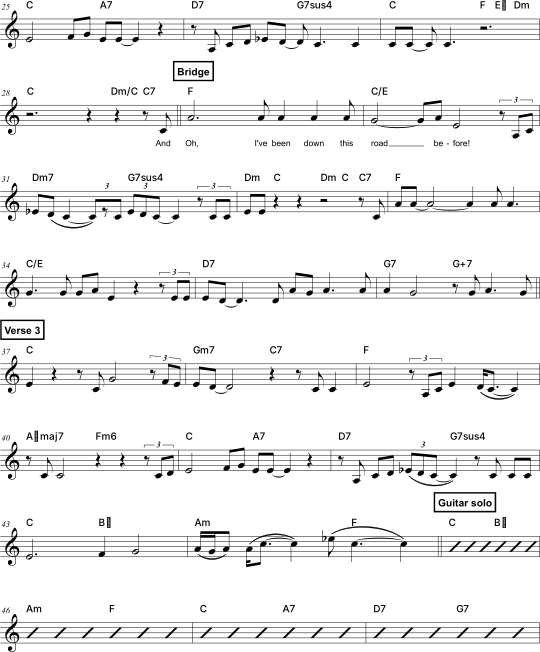
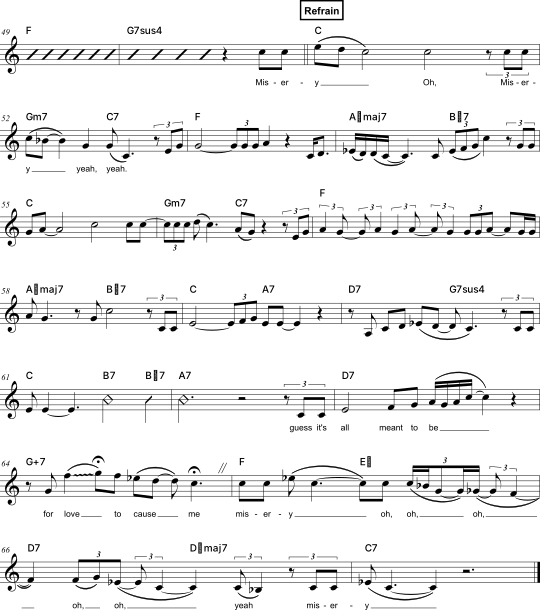
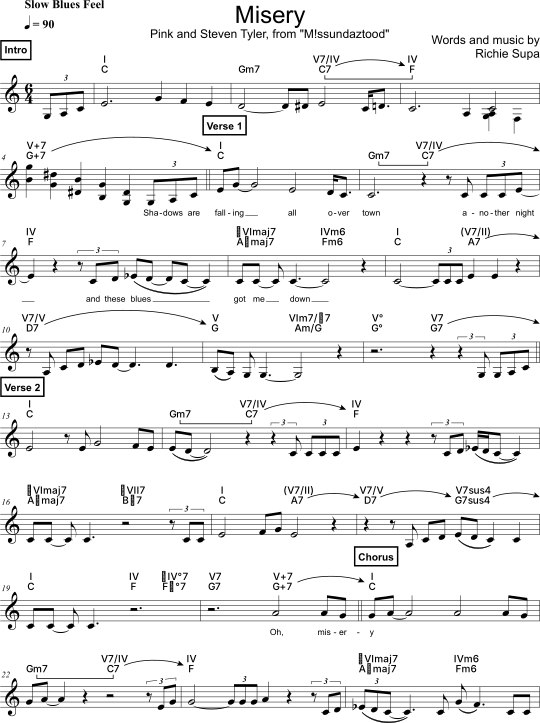
Click the link to listen to Richie Supa's "Misery" as performed by P!nk and Steven Tyler. Analyze the accompanying lead sheet (download PDF) using Roman numerals and graphic analysis symbols (parenthesis, brackets, and arrows). While there may be a few chords that you don't yet have a way to explain—we'll cover diminished 7th chords in future lessons—most of this tune should be completely comprehensible. In addition to diatonic chords, secondary dominants, related II chords, and modal interchange you'll also find a number of instances in which secondary dominants resolve deceptively. Use the answer key provided to check and correct your work.
Make It So!: Four- and Five-Part Voice Leading of Secondary and Extended Dominants
Music should roll on like a river. When water is obstructed or encounters obstacles it doesn't flow freely. Learning proper voice technique allows music to flow easily and to be as expressive as possible! In this topic you will learn how to voice lead extended dominant progressions in four- and five-note voicings with and without tension substitutions.
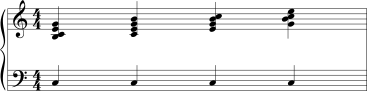
Five-Note Voicings: Four-Way Close Technique Over Root
In four-way close technique, all four notes of the chord are voiced as close together as possible, over roots in the bass. The starting position is arbitrary.
Multiple Four-Way Close Voicings of Cmaj7:
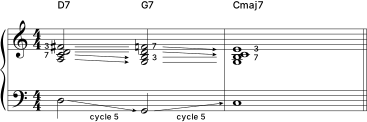
The voice leading procedure for four-way close technique in extended dominant progressions is pretty straightforward because the root motion is always by perfect 5th. When the root motion is Cycle 5 (shorthand for down a 5th –up a 4th), we connect the common tones between the chords and move the remaining notes downward by step. Once again, 3 will connect to 7 and vice-versa:
V7/V-V-I Pattern with Four-Way Close Voicing:
The guide tones (7ths and 3rds of the chords) will sound most effective if they are kept within the middle register. The lowest effective note for the 7th is E
Tension Substitutions on Four-Way Close Voicings
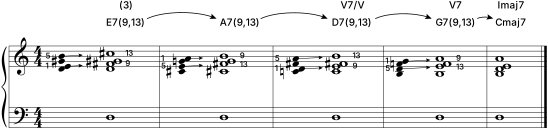
Depending on style and instrumentation, chord tones can be replaced by the appropriate available tensions, thickening and adding more color to the accompanying harmony. If the root is present in the bass, the root in the "upper structure" (the voices in the treble) of a four-way close voicing is redundant. It can be replaced by tension 9. The 5th is a non-essential chord tone and can be replaced by tension 13:
Extended Dominant Series Four-Way Close with Tension Substitutions:
Three-Way Close Technique Over Roots in Bass
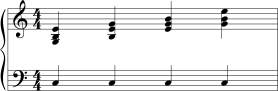
In three-way close technique, the 3rd, 5th, and 7th of the chord are voiced as close together as possible in the treble while the root is positioned in the bass. The starting position of the upper voices is arbitrary.
Multiple Three-Way Close Voicings of Cmaj7:
Three-Way Close Cycle-5 Root Motion – Free Resolution of the Guide Tones
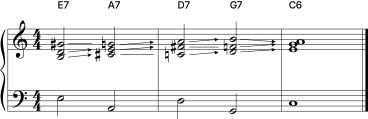
When root motion is by 5th as in an extended dominant series, there are two possibilities for voice leading procedure. In the first, the chord tones move by common tone and step. This results in free resolution of the melodic tendency of the guide tones. Notice how the 3rds and 7ths change position from chord to chord. While the voice leading is efficient, the continuity of each of the upper voices is slightly compromised because the guide tones are moving up away from their true melodic tendencies.
Fig 2.1
Three-Way Close Cycle-5 Root Motion – Strict Resolution of Guide Tones
The second procedure allows for strict resolution of the melodic tendency of the guide tones. This necessitates omitting the 5th of some chords and doubling the root. Notice below how the 5th has been omitted and the root doubled in the A7 and G7 chords. This allows the guide tones to follow a downward path within their respective voices and this in turn strongly supports the tonal progression.
Fig 2.2
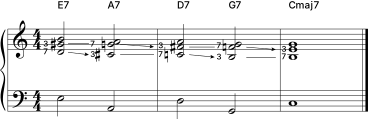
As in four-way close technique, tensions 9 and 13 can be substituted for the redundant root and the expendable 5th. Compare Figs. 2.1 and 2.2 above to see how tensions have been substituted for the root or the 5th in the highest voice of the chords of Fig. 2.1.
Tension Substitutions in Three-Way Close Voicings of an Extended Dominant Series:
Workshop: Four- and Three-Way Close Technique Practice
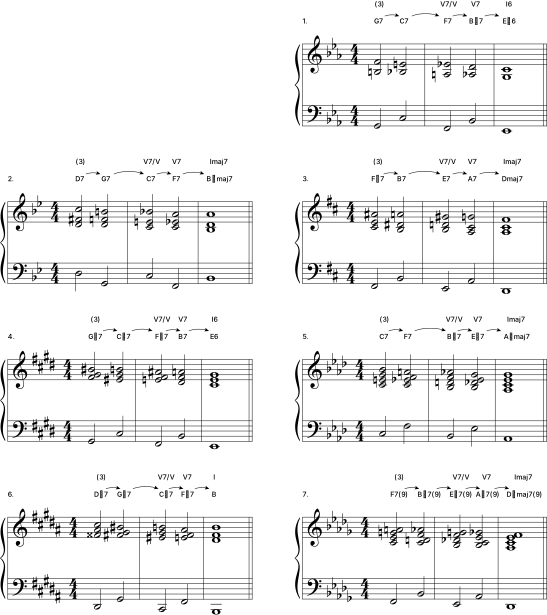
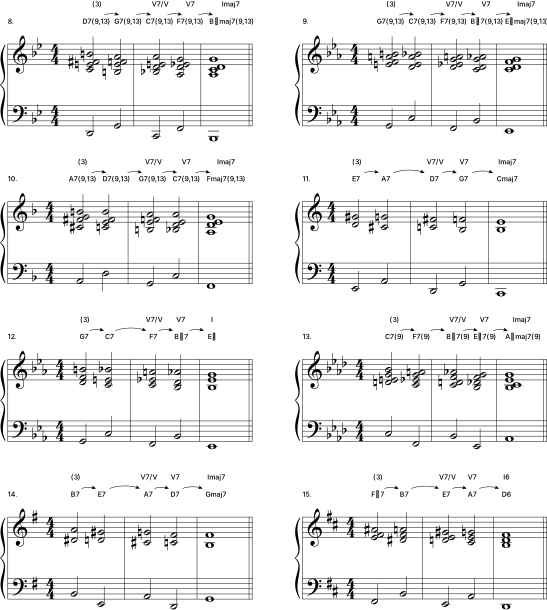
This workshop's PDF includes a number of phrases, each of which contains an extended dominant series resolving to the tonic chord of the given key. Realize the chord symbols with the number of voices specific to the first chord. You will have practice realizing these progressions in four-way close and three-way close technique with and without tension substitutions. You will also practice realizing the progressions in three voices, employing just guide tones and bass. Be sure to pay close attention to the key signature of each example and take care to use the appropriate accidentals for each chord. Analyze the harmony and correct your work using the answer key provided.
Download Four and Three-Way Close Technique Practice (PDF)
Composers on Composing: Music Theory and Creativity
This week, in lesson 2, three more composers share their thoughts on composition. They answer the same questions posed to week 1's composers:
How do you begin a composition?
How do you choose your compositional materials?
Composers interviewed in week 2:
Omar Thomas – Jazz composer
Sheldon Mirowitz – Film and TV composer
Winnie Dahlgren – Jazz composer
Recap
In this week's lesson we have learned how to:
understand the concept of the extended dominant series as distinct from secondary dominants
recognize an extended dominant series in a piece and analyze it correctly
express extended dominants appropriately as chord scales
recognize common deceptive resolution patterns for secondary dominants and analyze them appropriately
realize chord progressions that include both extended dominants and secondary dominants in four and five voices with and without tension substitutions
In next week's lesson we will be looking at the substitute dominant, related IIs, and extended substitute dominants.